
Knowledge
How Perfume Works: Understanding the Fragrance Pyramid
The Fragrance Pyramid Explained: Top, Heart & Base Notes
A perfume smells different over time because its aromatic materials evaporate at different rates. Fresh, highly volatile materials appear first, while less volatile woods, musks, resins and other substantive materials remain longer and shape the dry-down.
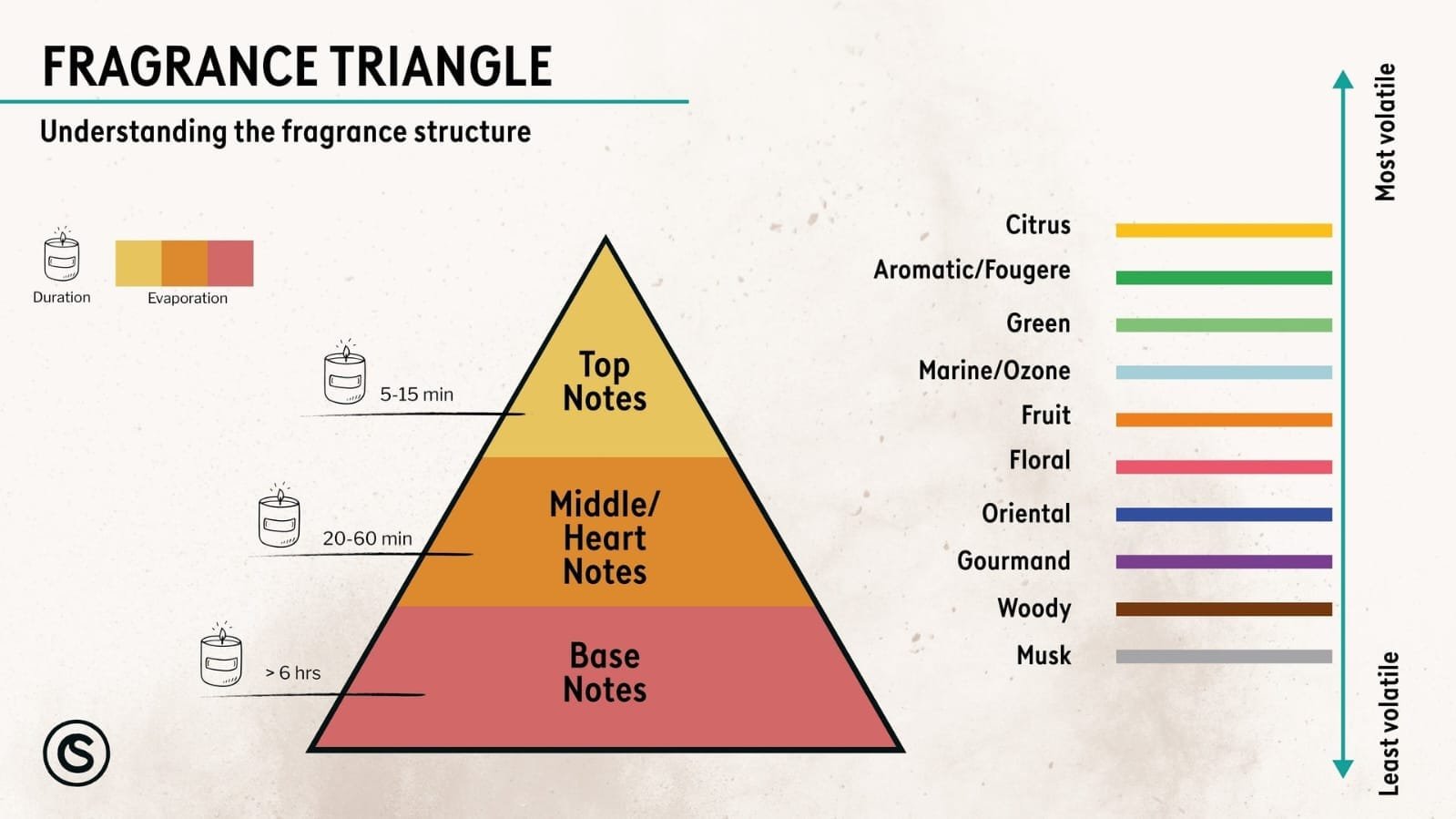
This structure is known as the Fragrance Pyramid, traditionally divided into Top Notes, Heart Notes and Base Notes. It is not a rigid formula; experienced perfumers use volatility, diffusion, molecular interactions and fixatives to make these stages blend rather than appear as three separate steps.
What Is the Fragrance Pyramid?
A fragrance contains dozens, sometimes hundreds, of aromatic materials with different evaporation characteristics. Citrus materials such as limonene can lift quickly from the skin, while materials such as patchouli, vetiver, sandalwood, vanillin and many musky or resinous materials have greater substantivity.
The pyramid is therefore a useful way to understand how a perfume develops:
- Top Notes – The opening impression.
- Heart Notes – The main character of the composition.
- Base Notes – The long-lasting dry-down.
The exact timing varies with concentration, formulation, skin temperature, humidity, application amount and the materials used.
Top Notes – The First Impression
Top notes are the materials that reach the nose most quickly after application. They tend to have higher volatility, so their strongest impression may last only a few minutes to roughly 15 minutes, although some aromatic materials can remain perceptible considerably longer.
A well-built opening is not simply about making a perfume smell strong. Its job is to provide lift, freshness and the first indication of the fragrance’s character while the slower materials begin to take over.
Common Top Notes
- Bergamot
- Lemon
- Orange
- Grapefruit
- Mandarin
- Lime
- Neroli
- Green Apple
- Pear
- Pineapple
- Mint
- Basil
- Lavender
- Fresh marine and ozonic accords
These materials can make a fragrance smell:
- Fresh
- Crisp
- Bright
- Clean
- Sparkling
- Energetic
Fragrance Families Commonly Found in Top Notes
- Citrus
- Green
- Marine and ozonic
- Aromatic
- Fresh fruity
The opening can be impressive, but it should never be the only stage considered when testing a perfume.
Heart Notes – The Character of the Perfume
As the most volatile materials diminish, the heart becomes easier to perceive. This stage commonly contains florals, herbs, spices, fruits and other materials selected to connect the opening with the deeper base.
Heart materials can remain noticeable for several hours, depending on the concentration and composition. A floral material such as rose absolute behaves very differently from a bright citrus oil, even though both can contribute to the overall impression of freshness or elegance.
Common Heart Notes
- Rose
- Jasmine
- Iris
- Gardenia
- Violet
- Orange Blossom
- Lavender
- Geranium
- Rosemary
- Cardamom
- Cinnamon
- Saffron
- Fruity accords
- Green accords
Fragrance Families Commonly Found in Heart Notes
- Floral
- Green
- Fruity
- Aromatic
- Spicy
The heart is often where a perfume’s intended personality becomes clearest.
Base Notes – The Long-Lasting Dry-Down
Base notes provide depth, body and persistence. Many base materials have lower volatility and high substantivity, allowing them to remain detectable on skin and fabric long after the brighter opening has disappeared.
This is why an oud, sandalwood, musk, patchouli or resinous fragrance can smell completely different several hours after application than it did during the first few minutes.
Common Base Notes
- White Musk
- Musk
- Oud
- Amber accords
- Sandalwood
- Cedarwood
- Patchouli
- Vetiver
- Vanilla
- Tonka Bean
- Leather accords
- Incense
- Benzoin
- Labdanum
- Oakmoss
Fragrance Families Commonly Found in Base Notes
- Woody
- Musky
- Amber
- Resinous
- Gourmand
- Earthy
A strong base does not automatically mean a perfume will last longer. The final performance depends on the complete formula, concentration, skin chemistry and the balance between volatile and substantive materials.
Fragrance Pyramid: How Each Layer Develops
| Stage | Typical Character | Common Materials | General Behaviour |
|---|---|---|---|
| Top | Fresh, bright, sparkling | Citrus, mint, herbs, light fruits | Evaporates fastest |
| Heart | Floral, spicy, aromatic, fruity | Rose, jasmine, cardamom, saffron | Forms the central character |
| Base | Woody, musky, warm, resinous | Oud, sandalwood, musk, vanilla, patchouli | Provides depth and persistence |
These time ranges are only guidelines. A perfume is a continuously changing mixture, not a timer that switches from one layer to another at a fixed minute.
Can the Same Note Appear in More Than One Layer?
Yes. The traditional pyramid is a communication tool, not a set of perfumery laws.
Citrus materials are normally associated with the opening, but a citrus accord can be supported by slower materials and remain noticeable into the heart. Floral materials usually dominate the heart, yet neroli and orange blossom can contribute to the opening as well.
Green materials can bridge the top and heart, while materials such as lavender can function across several stages depending on the surrounding formula.
A skilled perfumer considers the behaviour of the entire accord rather than assigning every ingredient to one box.
Why Do Oud, Musk, Amber and Woods Last Longer?
Longevity is influenced by volatility and substantivity rather than simply by whether a material is labelled a “base note.” Molecular structure, vapour pressure, interactions with the skin and the presence of fixative materials all influence how quickly an ingredient leaves the skin.
Materials such as patchouli, sandalwood, vetiver, vanillin, labdanum and many musks are comparatively persistent. Oud materials can also have substantial staying power, but natural oud oils vary considerably according to species, origin, distillation, aging and fractionation.
Does an Attar Follow the Same Fragrance Pyramid?
Yes, but the development can feel different from an alcohol-based perfume.
Traditional attars and modern perfume oils use an oil-based medium, while alcohol-based perfumes rely heavily on ethanol for rapid diffusion. Because an oil application generally evaporates and diffuses differently, an attar can feel smoother and closer to the skin while developing gradually.
A traditional dehn al oud may itself contain a complex mixture of volatile and less volatile compounds produced through distillation. The quality of the oud oil depends heavily on the raw material, distillation process, aging and the skill of the distiller.
Common materials found in rich attar compositions include:
- Oud
- Rose
- Musk
- Amber accords
- Sandalwood
- Saffron
- Incense
- Spices
One important correction to a common misconception: attar is not automatically highly concentrated simply because it is oil-based. Performance depends on the actual aromatic concentration, carrier, materials and formulation.
Skin Chemistry Changes the Fragrance
The same perfume can smell noticeably different on two people. Skin temperature, moisture, sebum, pH, perspiration and individual skin composition can influence evaporation and the way aromatic materials are perceived.
Dry skin often provides less oily material for fragrance molecules to interact with, which can make some perfumes seem to disappear faster. Applying fragrance to moisturised skin can therefore improve perceived persistence, although it does not transform a weak formula into a powerful one.
Why You Should Test a Perfume for More Than Five Minutes
The first impression tells you about the opening, not the complete fragrance.
For a meaningful evaluation, smell the perfume immediately after application, then again after approximately 30 minutes, 2 hours and several hours later. This reveals whether the opening, heart and dry-down actually suit your preferences.
A Simple Testing Method
- Apply a small amount to clean skin.
- Let it settle naturally without rubbing.
- Smell the opening after a few minutes.
- Recheck it around 30 minutes later.
- Evaluate the heart after 1–2 hours.
- Assess the dry-down several hours later.
This approach is especially useful when choosing an attar, oud oil or concentrated perfume.
Common Mistakes When Understanding Fragrance Notes
Judging a Perfume Only by Its Opening
A bright citrus opening may disappear quickly, revealing a completely different woody or musky character. Always give the fragrance time to reach its dry-down before deciding.
Assuming Every Listed Note Has Equal Strength
A note pyramid is not a recipe showing equal quantities. A perfume may list several ingredients that contribute only a subtle facet to the overall accord.
Assuming More Base Notes Always Mean Better Longevity
Longevity depends on the entire formulation. A well-balanced perfume can perform beautifully without being overloaded with heavy materials.
Treating Note Categories as Strict Rules
Modern perfumery frequently uses materials that bridge several stages. The fragrance pyramid is a useful map, but the actual scent experience is continuous.
Expert Fragrance Insight
Do not evaluate an oud, attar or perfume immediately after rubbing or repeatedly smelling it from the bottle. Give the material time to warm on the skin and develop; excessive rubbing can alter the way the fragrance spreads, while smelling directly from the bottle exaggerates volatile materials and tells you little about the true dry-down.
How to Choose a Perfume by Its Fragrance Pyramid
If you prefer fresh and energetic fragrances, look for citrus, green, marine, aromatic or fresh-fruity openings.
If you prefer floral and balanced fragrances, explore compositions built around rose, jasmine, iris, orange blossom, geranium or soft spices.
If you want a warm, deep and persistent character, look toward oud, sandalwood, patchouli, vetiver, musk, vanilla, amber and resinous materials.
The best choice is ultimately the fragrance whose complete development you enjoy—not simply the one with the most attractive first spray.
Frequently Asked Questions
What is a fragrance pyramid?
A fragrance pyramid is a traditional way of describing how a perfume develops through top, heart and base materials. It helps explain the changing character of a fragrance as different aromatic materials evaporate at different rates.
How long do top, heart and base notes last?
Top notes often dominate the first few minutes, heart notes become more prominent afterward, and base materials can remain for many hours. Exact performance varies with concentration, formula, skin chemistry, environment and application amount.
Does attar have top, heart and base notes?
Yes. Attars and perfume oils can contain materials with different volatility and substantivity, so they also develop from an opening through a heart and into a dry-down. Their oil-based format can make the transition feel smoother and less explosive than an alcohol-heavy spray.
Which fragrance notes last the longest?
Woody, musky, resinous and some gourmand materials are generally more persistent than highly volatile citrus and fresh materials. Oud, sandalwood, patchouli, vetiver, vanilla, labdanum and certain musk materials are commonly used to build a lasting foundation.
Discover the Art of Perfumery with Al-Majid Perfumes®
At Al-Majid Perfumes®, understanding fragrance structure is part of choosing the right scent—not simply reading a list of notes. From Arabian attars and oud compositions to body musks and Eau de Parfums, each fragrance develops according to the materials and concentration used in its formulation.
Explore the collection at Al-Majid Perfumes® and give every fragrance enough time to reveal its heart and dry-down before making your choice.
